Orange Ocellaris Clownfish — Amphiprion ocellaris
Orange Ocellaris Clownfish – Amphiprion ocellaris
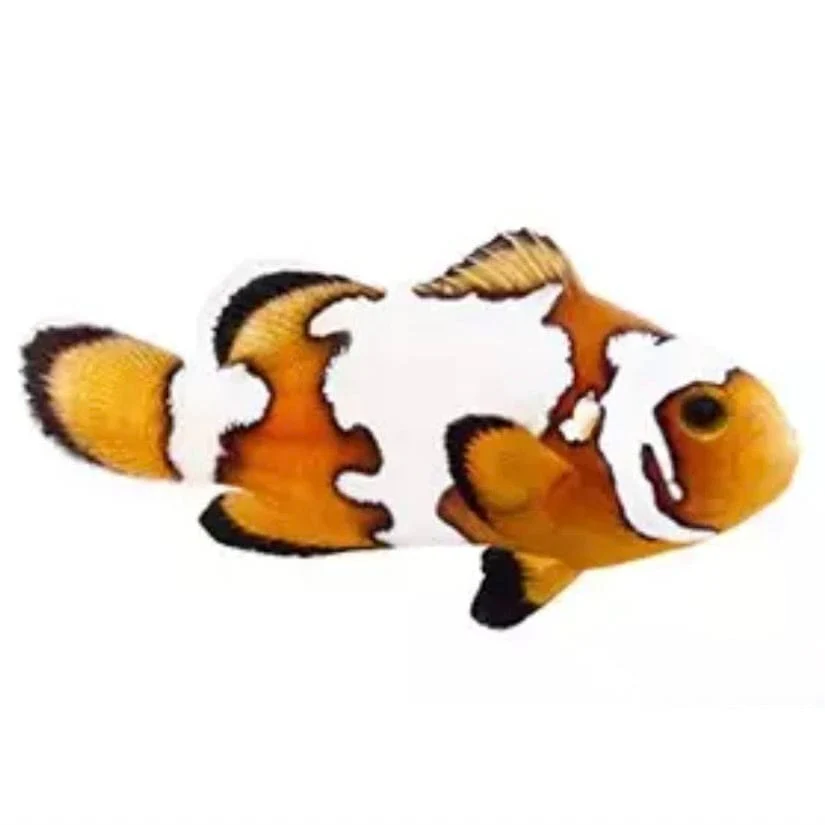
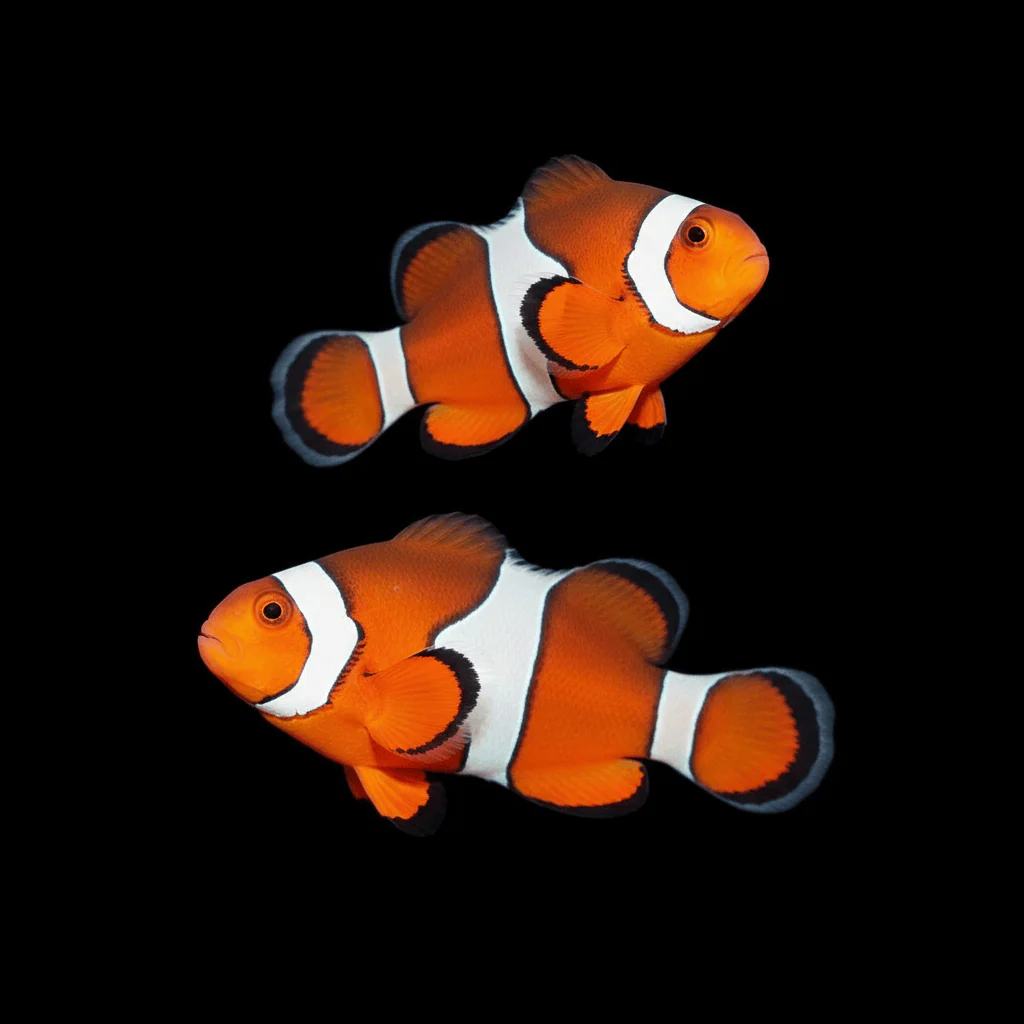
The Orange Ocellaris Clownfish is the classic wild-type form of one of the most recognizable saltwater fish in the aquarium hobby. Its vivid orange body is crossed by three clean white bands, each typically bordered by a narrow black margin. Rounded fins, an expressive face, and the species’ characteristic gently rocking swimming motion give this compact marine aquarium fish enduring appeal.
Native to the Indo-West Pacific, Amphiprion ocellaris occurs from the eastern Indian Ocean and northwestern Australia through Southeast Asia and the Philippines to Taiwan and the Ryukyu Islands. Wild fish inhabit shallow coral reefs and calm lagoons, where they live closely associated with large host anemones. Adults reach approximately 4.3 inches, with mature females growing larger than males.
Orange Ocellaris Clownfish are widely available as captive-bred specimens that adapt readily to prepared foods and aquarium conditions. Their manageable size, bold coloration, engaging social behavior, and reliable coral compatibility make them an excellent choice for established reef aquariums and peaceful fish-only aquariums. A host anemone is optional and is not required for successful long-term care.
Quick Care Guide
Care Level: Easy
Minimum Tank Size: 30 gallons
Temperament: Semi-aggressive
Diet: Omnivore
Reef Safe: Yes
Region: Indo-West Pacific
Scientific Name: Amphiprion ocellaris
Tank Requirements
Provide a stable saltwater aquarium with live rock, caves, overhangs, and at least one sheltered area the clownfish can establish as its territory. Although this species does not require extensive open-water swimming space, there should be enough room around its preferred shelter for feeding and for tankmates to avoid the defended area.
Sand, fine gravel, or a bare-bottom setup may be used because the fish has no specialized substrate requirement. Moderate, varied water movement is appropriate, provided the aquarium includes a calmer resting area. Protect exposed pump intakes and use a fitted lid or mesh cover as a general precaution.
A host anemone is not necessary. Captive-bred Ocellaris Clownfish may instead settle near a cave, coral colony, powerhead, aquarium corner, or another protected feature. Any anemone should only be added to a mature aquarium capable of meeting the animal’s separate lighting, water-quality, and feeding requirements. Captive-bred clownfish retain the instinct to associate with suitable anemones when one is present.
Diet and Feeding
The Orange Ocellaris Clownfish is an adaptable omnivore. Offer a varied diet of mysis shrimp, enriched brine shrimp, copepods, finely chopped shrimp or clam, frozen marine blends, and appropriately sized marine pellets or flakes.
Include spirulina-enriched flakes, algae-containing pellets, and other vegetable-based marine foods for nutritional balance. Captive-bred specimens usually accept prepared foods readily and should not require live food.
Feed one or two small portions daily. Juveniles and newly introduced fish may benefit from two smaller meals while they acclimate and establish a regular feeding response.
Temperament and Tankmates
Ocellaris Clownfish are among the more manageable clownfish species, but established individuals can become territorial around a cave, substitute host, anemone, or spawning site. A bonded pair may defend a relatively small area of the aquarium, with aggression becoming more noticeable when eggs are present.
Suitable tankmates include gobies, blennies, cardinalfish, firefish, peaceful wrasses, dwarf angelfish, and other community marine fish that will not harass or attempt to eat the clownfish. Avoid large predatory fish and highly aggressive species that may prevent it from feeding.
Keep one specimen or a compatible pair in most aquariums. Ocellaris Clownfish are protandrous hermaphrodites: the largest, dominant fish becomes female, while the smaller member of the pair remains male. Avoid combining two established females or maintaining multiple clownfish pairs in a modest aquarium, as territorial fighting may become severe.
Reef Compatibility
The Orange Ocellaris Clownfish is reef safe. It does not normally consume healthy stony corals, soft corals, zoanthids, clams, ornamental shrimp, crabs, or snails.
Some individuals may adopt a large-polyp stony coral, soft coral, mushroom, or other sessile animal as a substitute host. Repeated rubbing and vigorous movement can irritate a sensitive coral even though the fish is not feeding on it. Monitor any adopted coral that remains closed or begins showing signs of persistent stress.
Water Parameters
Temperature: 75–80°F
Specific Gravity: 1.024–1.026
pH: 8.1–8.4
Alkalinity: 8–12 dKH
Maintain dependable biological filtration, good oxygenation, and consistent salinity. Long-term stability is more important than repeatedly adjusting the aquarium to achieve one exact reading.
Common Considerations
-
A host anemone is optional: This clownfish can thrive with ordinary rockwork and secure shelter.
-
Expect territorial behavior: A settled individual or breeding pair may defend its chosen area.
-
Keep one compatible pair: Two mature females or multiple pairs may fight in confined aquariums.
-
Females grow larger: The dominant member of a pair develops into the female.
-
Do not confuse it with Amphiprion percula: Ocellaris Clownfish generally have thinner black borders around the white bands and typically possess 11 dorsal-fin spines.
Original: $25.00
-65%$25.00
$8.75Orange Ocellaris Clownfish — Amphiprion ocellaris
Orange Ocellaris Clownfish – Amphiprion ocellaris
The Orange Ocellaris Clownfish is the classic wild-type form of one of the most recognizable saltwater fish in the aquarium hobby. Its vivid orange body is crossed by three clean white bands, each typically bordered by a narrow black margin. Rounded fins, an expressive face, and the species’ characteristic gently rocking swimming motion give this compact marine aquarium fish enduring appeal.
Native to the Indo-West Pacific, Amphiprion ocellaris occurs from the eastern Indian Ocean and northwestern Australia through Southeast Asia and the Philippines to Taiwan and the Ryukyu Islands. Wild fish inhabit shallow coral reefs and calm lagoons, where they live closely associated with large host anemones. Adults reach approximately 4.3 inches, with mature females growing larger than males.
Orange Ocellaris Clownfish are widely available as captive-bred specimens that adapt readily to prepared foods and aquarium conditions. Their manageable size, bold coloration, engaging social behavior, and reliable coral compatibility make them an excellent choice for established reef aquariums and peaceful fish-only aquariums. A host anemone is optional and is not required for successful long-term care.
Quick Care Guide
Care Level: Easy
Minimum Tank Size: 30 gallons
Temperament: Semi-aggressive
Diet: Omnivore
Reef Safe: Yes
Region: Indo-West Pacific
Scientific Name: Amphiprion ocellaris
Tank Requirements
Provide a stable saltwater aquarium with live rock, caves, overhangs, and at least one sheltered area the clownfish can establish as its territory. Although this species does not require extensive open-water swimming space, there should be enough room around its preferred shelter for feeding and for tankmates to avoid the defended area.
Sand, fine gravel, or a bare-bottom setup may be used because the fish has no specialized substrate requirement. Moderate, varied water movement is appropriate, provided the aquarium includes a calmer resting area. Protect exposed pump intakes and use a fitted lid or mesh cover as a general precaution.
A host anemone is not necessary. Captive-bred Ocellaris Clownfish may instead settle near a cave, coral colony, powerhead, aquarium corner, or another protected feature. Any anemone should only be added to a mature aquarium capable of meeting the animal’s separate lighting, water-quality, and feeding requirements. Captive-bred clownfish retain the instinct to associate with suitable anemones when one is present.
Diet and Feeding
The Orange Ocellaris Clownfish is an adaptable omnivore. Offer a varied diet of mysis shrimp, enriched brine shrimp, copepods, finely chopped shrimp or clam, frozen marine blends, and appropriately sized marine pellets or flakes.
Include spirulina-enriched flakes, algae-containing pellets, and other vegetable-based marine foods for nutritional balance. Captive-bred specimens usually accept prepared foods readily and should not require live food.
Feed one or two small portions daily. Juveniles and newly introduced fish may benefit from two smaller meals while they acclimate and establish a regular feeding response.
Temperament and Tankmates
Ocellaris Clownfish are among the more manageable clownfish species, but established individuals can become territorial around a cave, substitute host, anemone, or spawning site. A bonded pair may defend a relatively small area of the aquarium, with aggression becoming more noticeable when eggs are present.
Suitable tankmates include gobies, blennies, cardinalfish, firefish, peaceful wrasses, dwarf angelfish, and other community marine fish that will not harass or attempt to eat the clownfish. Avoid large predatory fish and highly aggressive species that may prevent it from feeding.
Keep one specimen or a compatible pair in most aquariums. Ocellaris Clownfish are protandrous hermaphrodites: the largest, dominant fish becomes female, while the smaller member of the pair remains male. Avoid combining two established females or maintaining multiple clownfish pairs in a modest aquarium, as territorial fighting may become severe.
Reef Compatibility
The Orange Ocellaris Clownfish is reef safe. It does not normally consume healthy stony corals, soft corals, zoanthids, clams, ornamental shrimp, crabs, or snails.
Some individuals may adopt a large-polyp stony coral, soft coral, mushroom, or other sessile animal as a substitute host. Repeated rubbing and vigorous movement can irritate a sensitive coral even though the fish is not feeding on it. Monitor any adopted coral that remains closed or begins showing signs of persistent stress.
Water Parameters
Temperature: 75–80°F
Specific Gravity: 1.024–1.026
pH: 8.1–8.4
Alkalinity: 8–12 dKH
Maintain dependable biological filtration, good oxygenation, and consistent salinity. Long-term stability is more important than repeatedly adjusting the aquarium to achieve one exact reading.
Common Considerations
-
A host anemone is optional: This clownfish can thrive with ordinary rockwork and secure shelter.
-
Expect territorial behavior: A settled individual or breeding pair may defend its chosen area.
-
Keep one compatible pair: Two mature females or multiple pairs may fight in confined aquariums.
-
Females grow larger: The dominant member of a pair develops into the female.
-
Do not confuse it with Amphiprion percula: Ocellaris Clownfish generally have thinner black borders around the white bands and typically possess 11 dorsal-fin spines.
Product Information
Product Information
Shipping & Returns
Shipping & Returns
Description
Orange Ocellaris Clownfish – Amphiprion ocellaris
The Orange Ocellaris Clownfish is the classic wild-type form of one of the most recognizable saltwater fish in the aquarium hobby. Its vivid orange body is crossed by three clean white bands, each typically bordered by a narrow black margin. Rounded fins, an expressive face, and the species’ characteristic gently rocking swimming motion give this compact marine aquarium fish enduring appeal.
Native to the Indo-West Pacific, Amphiprion ocellaris occurs from the eastern Indian Ocean and northwestern Australia through Southeast Asia and the Philippines to Taiwan and the Ryukyu Islands. Wild fish inhabit shallow coral reefs and calm lagoons, where they live closely associated with large host anemones. Adults reach approximately 4.3 inches, with mature females growing larger than males.
Orange Ocellaris Clownfish are widely available as captive-bred specimens that adapt readily to prepared foods and aquarium conditions. Their manageable size, bold coloration, engaging social behavior, and reliable coral compatibility make them an excellent choice for established reef aquariums and peaceful fish-only aquariums. A host anemone is optional and is not required for successful long-term care.
Quick Care Guide
Care Level: Easy
Minimum Tank Size: 30 gallons
Temperament: Semi-aggressive
Diet: Omnivore
Reef Safe: Yes
Region: Indo-West Pacific
Scientific Name: Amphiprion ocellaris
Tank Requirements
Provide a stable saltwater aquarium with live rock, caves, overhangs, and at least one sheltered area the clownfish can establish as its territory. Although this species does not require extensive open-water swimming space, there should be enough room around its preferred shelter for feeding and for tankmates to avoid the defended area.
Sand, fine gravel, or a bare-bottom setup may be used because the fish has no specialized substrate requirement. Moderate, varied water movement is appropriate, provided the aquarium includes a calmer resting area. Protect exposed pump intakes and use a fitted lid or mesh cover as a general precaution.
A host anemone is not necessary. Captive-bred Ocellaris Clownfish may instead settle near a cave, coral colony, powerhead, aquarium corner, or another protected feature. Any anemone should only be added to a mature aquarium capable of meeting the animal’s separate lighting, water-quality, and feeding requirements. Captive-bred clownfish retain the instinct to associate with suitable anemones when one is present.
Diet and Feeding
The Orange Ocellaris Clownfish is an adaptable omnivore. Offer a varied diet of mysis shrimp, enriched brine shrimp, copepods, finely chopped shrimp or clam, frozen marine blends, and appropriately sized marine pellets or flakes.
Include spirulina-enriched flakes, algae-containing pellets, and other vegetable-based marine foods for nutritional balance. Captive-bred specimens usually accept prepared foods readily and should not require live food.
Feed one or two small portions daily. Juveniles and newly introduced fish may benefit from two smaller meals while they acclimate and establish a regular feeding response.
Temperament and Tankmates
Ocellaris Clownfish are among the more manageable clownfish species, but established individuals can become territorial around a cave, substitute host, anemone, or spawning site. A bonded pair may defend a relatively small area of the aquarium, with aggression becoming more noticeable when eggs are present.
Suitable tankmates include gobies, blennies, cardinalfish, firefish, peaceful wrasses, dwarf angelfish, and other community marine fish that will not harass or attempt to eat the clownfish. Avoid large predatory fish and highly aggressive species that may prevent it from feeding.
Keep one specimen or a compatible pair in most aquariums. Ocellaris Clownfish are protandrous hermaphrodites: the largest, dominant fish becomes female, while the smaller member of the pair remains male. Avoid combining two established females or maintaining multiple clownfish pairs in a modest aquarium, as territorial fighting may become severe.
Reef Compatibility
The Orange Ocellaris Clownfish is reef safe. It does not normally consume healthy stony corals, soft corals, zoanthids, clams, ornamental shrimp, crabs, or snails.
Some individuals may adopt a large-polyp stony coral, soft coral, mushroom, or other sessile animal as a substitute host. Repeated rubbing and vigorous movement can irritate a sensitive coral even though the fish is not feeding on it. Monitor any adopted coral that remains closed or begins showing signs of persistent stress.
Water Parameters
Temperature: 75–80°F
Specific Gravity: 1.024–1.026
pH: 8.1–8.4
Alkalinity: 8–12 dKH
Maintain dependable biological filtration, good oxygenation, and consistent salinity. Long-term stability is more important than repeatedly adjusting the aquarium to achieve one exact reading.
Common Considerations
-
A host anemone is optional: This clownfish can thrive with ordinary rockwork and secure shelter.
-
Expect territorial behavior: A settled individual or breeding pair may defend its chosen area.
-
Keep one compatible pair: Two mature females or multiple pairs may fight in confined aquariums.
-
Females grow larger: The dominant member of a pair develops into the female.
-
Do not confuse it with Amphiprion percula: Ocellaris Clownfish generally have thinner black borders around the white bands and typically possess 11 dorsal-fin spines.